DJ's not a big fan of museums! You may have noticed that I've mentioned that a few times before. So...I was excited when the wife of one of DJ's Houston co-workers wanted to go do some sightseeing with me on Tuesday while the guys were in their meetings all day. Jaime had her 4-month-old son with her (incidentally, he was as good as gold the entire trip). The three of us headed to the Museum of Navarre.
My pictures don't do the exhibits justice---there's my lack of ability and the fact that we couldn't use a flash and the fact that we were kind of crusing because there were five floors and an adjoining church to see. The exhibits were arranged by time period on certain floors. Who knows if I'll get the right pictures in the right place, but there were some incredible things to see. I am still amazed that all the archeological artifacts were found in the Navarre region. It's not like they've brought things in from all over.
WARNING: The next few paragraphs might seem like a history lesson, but I want to remember how things fit together and some of the things I may have learned (but am not likely to remember in years to come). Feel free to skip to the pictures OR skip this blog entirely!
Basement - Prehistory/Protohistory and Romanization - The oldest artifacts here date back to the Palaeolithic period and include things used by people who lived by hunting and fishing and who made their homes at the entrances to caves. The Neolithic period saw pottery produced (can you believe these awesome pieces) and stone was polished. Agriculture and the domestication of animals began as well as settlements.
From 1000 to 900 BC Celts and Indo-Europeans began arriving in the area. Their archeological remains are classified as the Iron Age. Handmade ceramics and different types of adornments like clasps, brooches, and buttons were made. The Second Iron Age is marked by the appearance of the potter's wheel and iron implements and tools. Roman legions arrived in the area around 200 BC. Romanization developed in the second and first centuries BC and that's when Pamplona was founded (75 BC). For the first five centuries AD, Roman settlements abounded. At the end of the Roman Empire, there were homes decorated with mosaic floors and painted stucco walls. There were beauifully salvaged examples of the mosaics in several places in the museum and outside in the courtyard as well.
Have a looksie:
![]() |
| I took a close-up of these necklaces because they reminded me of something you'd see in a high-end boutique today (minus the string)! |
![]() |
| Don't some of these look like golf balls? |
![]() |
| Roman Currency |
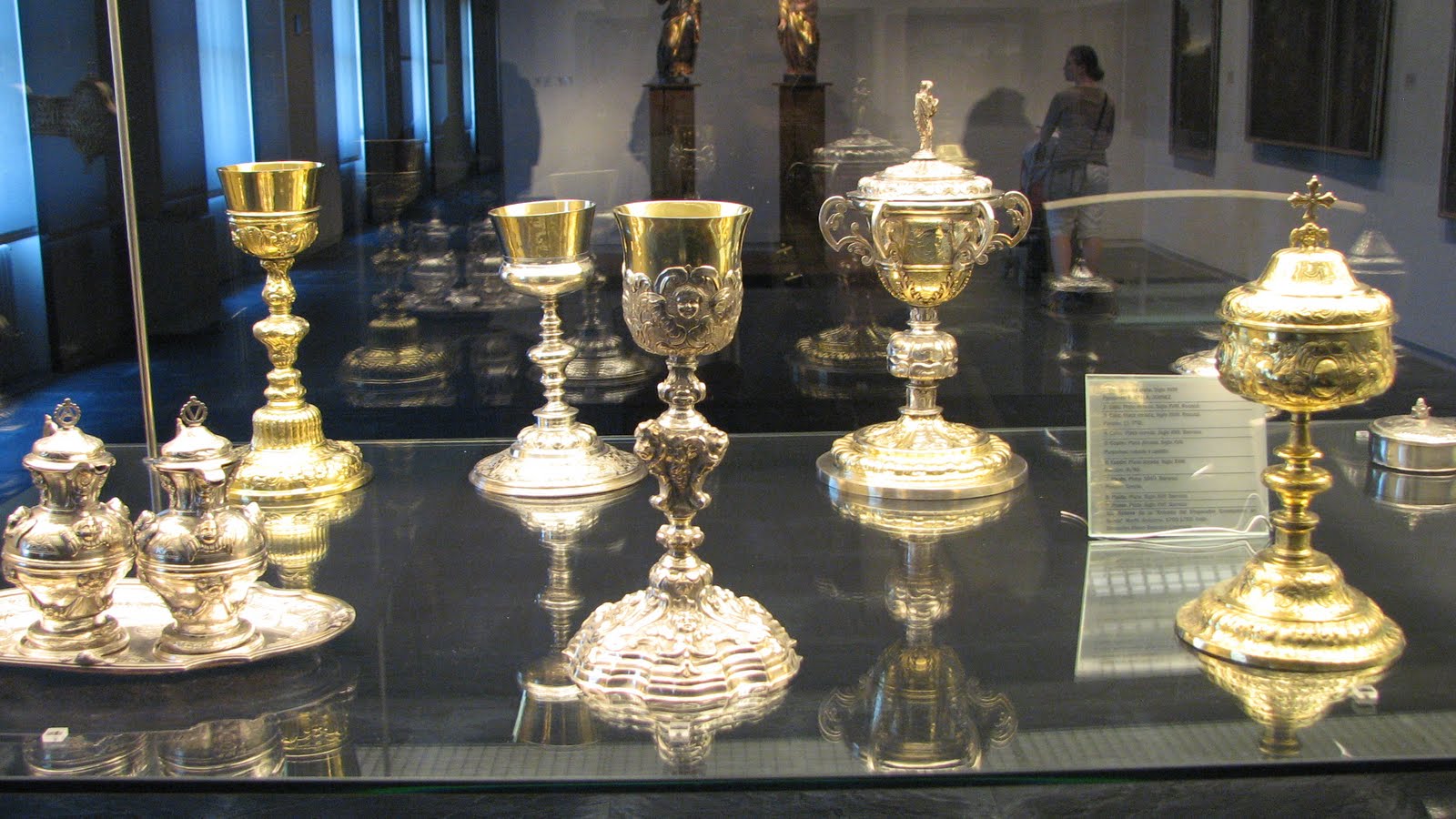
First floor - Roman and Medieval - The museum has a wonderful assortment of medieval art which was gathered from a number of places in the old kingdom. There are many rich examples of the high level achieved by artists who once lived in the Kingdom of Navarre. The brochure from the museum says that "the most outstanding work is, without a doubt, the Spanish-Muslim ivory chest" from a monastery which was used as a shrine. I just happened to get a picture (see below). There were many sculptures, paintings, and silverwork which highlighted the cultural wealth that existed in Navarre in the Late Middle Ages.
I think this is where we went upstairs to the second floor, but it could have been a little later. We got to view this two-story piece from both floors. Most of that floor was full of work from the Renaissace, the Baroque period, and the 18th century.
![]() |
| There was a whole series of art about Adam and Eve. The one above shows them cast out of the garden, with children, subject to death, having to toil and work. The one below shows them offering sacrifice. The third one is of Cain and Abel. |
The third floor is full of art (all paintings if I remember right) from the 18th and 19th century. It was interesting, but by far the most famous painting there was one of Marques de San Adrian, signed and dated by Francisco De Goya---pretty sure it was among those we studied back in Humanities 101. However, the batteries on the ol' camera were starting to go, and I didn't take pictures there nor on the 4th floor which was 20th century art by those native to or those who resided in Navarre. The collection is not very large, and the exhibit was still under construction.
Most of the museum is housed in an old hospital. There is a Gothic church dating back to the 16th century attached to the museum/used to be hospital, which used to be the hospital chapel and was used as a place of worship until recently.
![]() |
| The museum entrance is in the old hospital where the sculpted relief, which dates back to 1556, encases the arched entrance. The Gothic church is to the right. We climbed up a circular staircase in that turret to get to the organ loft. |
Now, the old church is used to house the Museum's religious art and as an auditorium:
See, that's what I meant when I said there was a lot more to Pamplona than bulls. I am still amazed that so many archeolgical artifacts were found in and that so much art came out of such a small area in Spain. It was such an enlightening way to spend a morning!